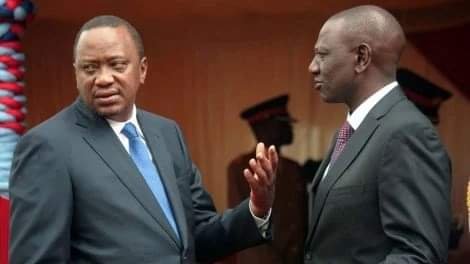
Tireless efforts by the clergy to reconcile President Uhuru Kenyatta and his Deputy President William Ruto seem to have hit a dead-end with a section of clerics terming their differences “deep-rooted”.
Last Week ,The religious leaders who had begun the initiative sometimes last year before their efforts were temporarily disrupted by the Covid-19 pandemic, are, however, hoping they can still broker a successful deal between the two leaders.
The clergy further regretted that the differences between the two top leaders were already creating anxiety among Kenyans and have potential to ignite political violence if not addressed immediately.
According to latest revelation by a Popular weekly tabloid, both president Uhuru Kenyatta and his estranged Deputy William Ruto went a series of disagreements which culminated into their bitter separation that has been characterized by State humiliation ,persecution of DP Ruto’s allies and constant calls by Kieleweke leaders for Ruto to resign. Its believed that some of the woes are political especially on succession while some, have to do with economic deals and control of vast multibillion programs.
Local bloggers also exposed a strained relationship between the two duos.The two reportedly differed over bank roll out on Fuliza program which allows MPESA users through Safaricom to acquire instant loans even if their balance are insufficient. This happened months after the 2017 repeat elections.
“While DP William Ruto fronted the Kenya Commercial Bank (KCB) to roll out the program, President Uhuru Kenyatta and Baringo Senator Gideon Moi teamed up to front his family’s National Commercial Bank of Africa (NCBA) that eventually bagged the deal singlehandedly despite an earlier agreement that KCB would also be part and parcel of this program,” a statement read according to an insider.
Notably, both the Moi and the Kenyatta families have a history of having a joint business relations, with the Moi family controlling major shareholders at Safaricom.
Fuerthermore, the raw deal DP William Ruto losing Billions of money if KCB would have won the Fuliza program.
The Weekly Citizen sources further reveal that DP William Ruto spared no energy and well all out, during the proverbial ‘Burning the midnight oil” to campaign for president Uhuru’s re-ection with the hope of bagging millions from the deal, so he may use during the 2022 general elections
Insiders further intimate that the move angered the Deputy President so much and to make the matters worse,president Uhuru in 2018 went for a historic handshake with Ruto’s long time political enemy Raila Odinga, thus escalating the fallout further.
With this imminent fallout through handshake, DP William Ruto was completely kicked out of the Fuliza deal and his tireless efforts to have KCB roll out the project bored no fruits.
“Its said,Ruto handlers had opened a bank account in Dubai where commissions from the Fuliza deal would be deposited,” read part of the statement by Citizen Weekly.
Retired African Inland Church (AIC) Bishop Silas Yego and Archbishop Muheria, have quietly been working alongside the head of the Anglican Church of Kenya Archbishop Jackson ole Sapit, Kisumu Catholic Archbishop Philip Anyolo and Bishops David Oginde (retired head of Christ is The Answer Ministries, CITAM) and Robert Lang’at of African Gospel Church (AGC) to reconcile the two politicians.
Sources within the team, who declined to be named due to the sensitivity of the matter, intimated to People Daily that efforts to reconcile the two leaders had “almost collapsed” because of apparent irreconcilable differences between them.
While President Kenyatta reportedly complains of being slighted by his deputy, Ruto has allegedly been accusing his boss of shortchanging him on their 2013 deal as well as not recognising and appreciating the role he played in his election to State House.
The source said President Kenyatta has never been comfortable with his deputy’s claim to a “shared presidency” and exploiting the 2010 Constitution that gives him immunity from being sacked, to allegedly disrespect the Head of State.
“Theirs is a problem that seems to have began simmering almost six years ago before it erupted publicly in 2018. The differences have to do with something much bigger than what we know,” said the source